


Chcesz skorzystać z porady eksperta?
Zadzwoń na nr: +48 605 558 277
lub wypełnij i wyślij poniższy formularz

Innovative products for health, beauty and a slim figure
OUR OFFER
ProOptical Advanced Formula
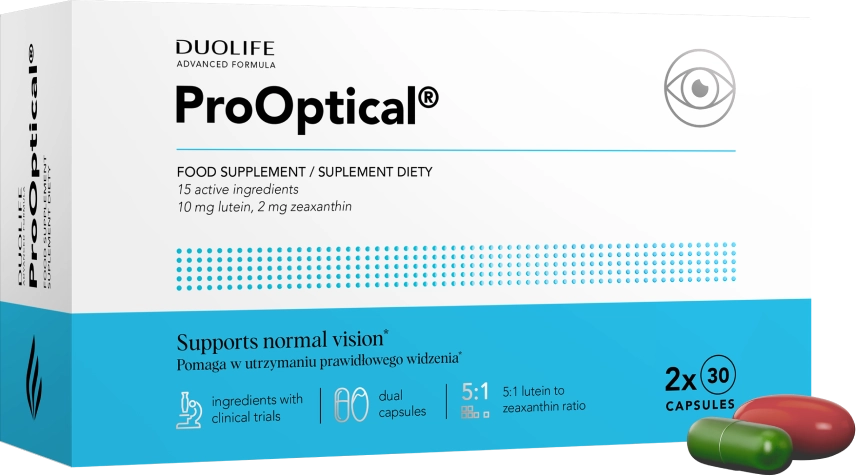 ProOptical® is a food supplement consisting of 2 complementary capsules. The product contains valuable active ingredients enclosed in two types of capsules: a "softgel" capsule and a hard capsule.
Main benefits:
- Supports the maintenance of normal vision (zinc).
- Visual clarity, acuity and sharpness (bilberry).
- Helps maintain normal retina function (bilberry).
- Helps protect cells against oxidative stress (bilberry, grape seeds, zinc, vitamin C).
Precautions: hypersensitivity to any of the product ingredients. Avoid if pregnant or breastfeeding. Do not use in infants, children and teenagers under 14 years of age. Should not be taken if you are consuming other products containing astaxanthin esters on the same day. If you take antidepressants or anticoagulants, consult a doctor or a pharmacist before starting the supplementation. If you have a chronic condition or are taking medication, consult your doctor before using the product.
|
|
Delayed release of active ingredients from a hard capsule. |
|
|
Lutein to zeaxanthin ratio: 5:1. |
|
|
Naturally sourced ingredients. |
|
|
A ‘softgel’ capsule with carotenoids suspended in perilla frutescens seed oil. |
 |
A combination of two capsule types in one product. |


"Softgel" capsule Contains carotenoids: - lutein, - zeaxanthin, - astaxanthin-rich oleoresin from Haematococcus pluvialis algae. Organic perilla seed oil.
|
||
Hard capsule A proprietary formula of extracts standardised to contain 25% anthocyanins sourced from: - chokeberry fruit, - honeyberry, - European blueberry. Proprietary formula derived from inactivated yeast cells of Saccharomyces cerevisiae standardised for 5% zinc content. Plant extracts sourced from:
|
||


How do the ingredients of ProOptical® support your body?

Ingredients:
Cold-pressed perilla (Perilla frutescens) oil perilla is an oily plant rich in essential fatty acids (EFAs), especially the very important omega-3 acid: alpha-linolenic acid (α-linolenic acid, ALA). In the body, ALA give rise to the entire family of omega-3 acids. Of ALA derivatives, the most important ones are docosahexaenoic (DHA) and eicosapentaenoic (EPA) acids. DHA is commonly found in cell/plasma membranes in the entire body. It is a main structural factor of cell membranes in brain cortex neurones in the central nervous system (up to 50% of the entire fraction of membrane phospholipids) and cell membranes of rods and cones in the retina, responsible for the night and the colour vision. Perilla oil is also a 'biological background' improving absorption of active ingredients contained in the inner softgel capsule of ProOptical®.
|
||
Plant carotenoids: lutein, zeaxanthin, astaxanthin Carotenoids are colourants synthesised by plants, fungi, bacteria and algae. These colourants participate in many biological processes of plants, are responsible for the colour of many fruits and flowers, and have strong antioxidative properties, helping to protect plant cells against adverse factors. The human body can’t synthesise carotenoids, so they must be supplied with plant-based products.
|
||
Lutein and zeaxanthin are natural carotenoids found in the human macula. Lutein and zeaxanthin levels in the macula decrease with age. This results in a greater susceptibility of the macular photoreceptors (cones and rods) to harmful effects of blue light from the UV range. Both lutein and zeaxanthin have to be supplied to the body with plant foods; humans cannot synthesise these compounds. Unfortunately, in European countries their consumption is several times below the estimated consumption of at least 6 mg a day.
|
||
Mexican marigold flowers are a valuable source of these two carotenoids. The form of lutein and zeaxanthin used and the fatty environment (presence of fatty acids found in perilla oil) enhance their bioavailability. In the body, lutein and zeaxanthin undergo similar transformations as lipids. When ingested with food, after digestion they are transported to the liver and from the liver to the tissues; both compounds accumulate mainly in the lens of the eye and in the central part of the retina – the macula. The quantitative ratio of lutein to zeaxanthin in the whole preparation is 5:1; this is the optimal ratio of these ingredients, considered also in clinical trials and recommended worldwide.
|
||
Astaxanthin also known as 'the queen of carotenoids', is a compound from the xantophyll group, which occurs naturally in the environment. Astaxanthin biosynthesis is done only by some species of algae, yeast, Gram-negative bacteria and plants. Astaxanthin is responsible for the colour of flowers and fruit and has strong antioxidative properties, protecting cells against external factors. The main source of astaxanthin in human diet are fish and seafood. Also in the case of astaxanthin, oily environment (the presence of fatty acids found in perilla oil) enhances the bioavailability of lutein and zeaxanthin.
|
||
Proprietary formula derived from inactivated yeast cells of Saccharomyces cerevisiae standardised for 5% zinc content. The formula of the preparation with standardised content of zinc is obtained in the process of fermentation and then inactivation of special lines of Saccharomyces cerevisiae yeast.Yeast – a natural wealth of many vitamins and minerals, are cultured and additionally nourished, and then processed and dried under mild conditions, which allows the interaction of preserved vitamins and nutrients with the natural yeast matrix, which is their 'biological background' and guarantees their durability and quality. The resulting final product contains a complex of natural, perfectly absorbable nutrients, with a specific, standardised amount of zinc. Zinc:
|
||
Proprietary formula composed of chokeberry and honeyberry extracts standardised to contain 25% of anthocyanins – anthocyanins are pigments belonging to the flavonoid group which can be widely found in plants. The highest concentrations of these pigments can be found in flowers, fruits, and leaves. Grapes, chokeberry, blackcurrant and berries are richest in anthocyanins. Chokeberry fruits contain anthocyanins, flavonols, phenolic acids and tannins, as well as vitamins (C, B2, B6, E, P, PP) and mineral ingredients (molybdenum, manganese, copper, boron, iodine, cobalt). Polyphenols are probably the most important active ingredients of the chokeberry fruit, responsible for the majority of their health promoting properties.
|
||
Honeyberries are rich in phenolic compounds and have a high concentration of polyphenols, including anthocyanins and proanthocyanidins. Honeyberries are an extremely valuable source of vitamin C. They also contain B vitamins, magnesium, phosphorus, calcium and potassium.
|
||
Bilberries are one of the most valuable sources of anthocyanins. Bilberries also contain tannins – gallotannins and ellagitannins; flavonoids – quercetin, catechins; phenolic acids – gallic acid; and hydroxycinnamic acids – chlorogenic acid. Bilberries help protect the eyes by supporting transparency, clarity and sharpness of vision, normal retinal function, blood flow to the eye and natural defences against free radicals. Anthocyanosides:
Bilberry anthocyanosides can help maintain optimal capillary health and vein elasticity against free radical damage.
|
||
Acerola fruit extract standardised for 50% vitamin C content – acerola fruits contain a very high dose of vitamin C; 100 g fresh fruit weight contains 1,000–4,500 mg of this vitamin. Moreover, acerola fruits contain many other valuable compounds, such as anthocyanins and carotenoids, including beta-carotene (provitamin A) and mineral ingredients (potassium, phosphorus, calcium, iron). Additionally, group B vitamins are also found in these fruits. Vitamin C:
|
||
Elderberry fruit extract standardised to contain 10% polyphenols – the main bioactive components in elderberry fruit are anthocyanins (significant content: 0.2-1%), flavonols, organic acids, vitamin C, B vitamins (including folic acid), minerals (potassium, calcium, phosphorus) and carbohydrates (mainly simple sugars: glucose and fructose).
|
||
Blackcurrant leaf extract blackcurrant leaves are a valuable source of bioactive compounds (polyphenols) with antioxidative properties. The main phenol compounds found in the leaves include quercetin, myricetin and rutin.
|
||
Schisandra fruit extract standardised to contain 10% schisandrin – the Schisandra berry is naturally found in mountain forests and river valleys, mainly in Russia, Korea, Japan and China. In Chinese, the name of this plant means 'fruit of five flavours', as the skin and flesh taste sweet and sour, while the seeds are tangy, bitter and salty. In Asia, Schisandra is grown not only for decorative purposes, but above all for its fruit, which is rich in many valuable nutrients. The most important group of compounds present in the Schisandra berries include polyphenols – lignans (schisandrols and schisandrins). Additionally, the fruits are rich in organic acids (such as citric and malic acid), vitamins (such as vitamin C and E), and minerals (such as zinc, manganese, copper and iron). Schisandra berry also contains tannins, carbohydrates and an essential oil rich in citral whose smell resembles lemons. Schisandra berry fruit extract has adaptogenic properties.
|
||
Tomato extract standardised for 5% lycopene content – lycopene is a natural carotenoid found in high levels in tomato fruit. Fresh tomatoes can contain up to 20 mg of lycopene per 100 grams. Other vegetables and fruits (especially those with a red colour) such as watermelon, red grapefruit, rosehip fruit, red peppers, guava and papaya are also its sources.
|
||
Grape seed extract standardised to contain 95% proanthocyanidin – apart from sugars, proteins and lipids, grape seeds contain also 5–8% of polyphenols. Polyphenols found in the seeds include catechins, proanthocyanidins, resveratrol and phenolic acids. Grape seeds foster venous circulation. They boost protection against free radicals
|
||
Saffron stigma extract saffron has been known for many thousands of years as a valuable plant and spice. The active ingredients of the saffron are its essential oils and glycosides: crocetin and crocin, responsible for its yellow-orange colour, picrocrocin, giving it its taste, and safranal, responsible for its smell. Crocetin, crocin and safranal are mainly responsible for saffron’s valuable properties.
|
||


Instructions for use:
Instructions for use: 1 hard capsule and 1 soft capsule daily, preferably during the main meal. Do not exceed the recommended maximum daily dose. The product cannot be a substitute for a varied diet. A balanced diet and healthy lifestyle are essential for the proper functioning of the body. |
||

Watch an educational video:
Storage:
Storage: Store at room temperature, keep out of reach of children.
Given the nature of the soft capsule, slight sedimentation or separation of the ingredients may occur. This process is natural and does not affect use.
Care for the environment with DUOLIFE and sort waste!
After finishing the product, think about the environment. Throw the box, leaflet and blister into the appropriate waste bins.
Environment table:
|
|
|||
|
|
Pudełko / Scatola / Carton box / Packung |
PAP 21 |
PAPIER / CARTA¹ / PAPER / PAPIER |
|
|
Ulotka / Volantino / Leaflet / Packungsbeilage |
PAP 22 |
PAPIER / CARTA¹ / PAPER / PAPIER |
|
|
Blister / Blister / Blister pack / Blister |
C/PVC 90 |
PLASTIK / PLASTICA¹ / PLASTIC / PLASTIK |
| ¹ Raccolta differenziata. Verifica Ie disoosizioni del tuo Comune. |
|||


Recommended products:
OFFER
Information
Contact
Copyright - Vitnatura. All rights reserved
© 2021